Before the Meeting: A Conversation with Erik Spiekermann
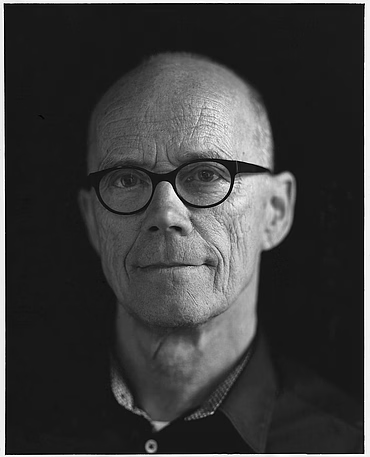
Erik Spiekermann is one of the most influential typographers and graphic designers of the last half century. He founded MetaDesign and EdenSpiekermann, designed typefaces used by some of the world's most recognized brands, and has spent decades thinking about how designers work — not just what they produce.
In June 2026, Erik Spiekermann was awarded the Gutenberg Prize by the International Gutenberg Society and the City of Mainz — one of the most prestigious honors in the field of printing and typography, recognizing his lifelong contribution to typeface design, digital type infrastructure, and the preservation of letterpress tradition.
I reached out to him because I had a feeling something was amiss in how design work happens today. This conversation confirmed it.
I've been working as a designer for fifteen years, almost entirely in digital and corporate environments. And something feels missing. A lot of my career has been built around meetings — everything goes through scheduled calls. I never really experienced studio life. I'm trying to understand what was there before all of this.
I have very strong opinions about this. The way I always worked was in a studio that was open — you didn't really need meetings because things were kind of open anyway. When I had forty, seventy people, I would walk around every morning between nine and twelve. I could quickly see what somebody was working on — at least which project, which stage. And if I saw the same screen with the same person for three days, I knew either they were bored or they didn't know what to do anymore. Then I had to interfere. I saw myself as the personal connection. I knew that Adam was doing this and Eve was doing this over here — maybe they have the same question, the same issue, the same stage. So I would say: why don't you go talk to her? I wouldn't call that a meeting. Meetings, I avoided as much as I could. The only meetings we always had were with clients. And clients like meetings because they're more entertaining than sitting at their desks. They can have coffee and biscuits and talk all day and pretend they've worked.
I see this now in corporate design teams. Six, seven, ten designers sitting next to each other, looking at their monitors. They don't talk. They schedule meetings to talk about projects. Even when they're in the same room.
That's a terrible culture. But we can change it. I had a letterpress workshop with a large space upstairs that we rented out to half a dozen people — a programmer, a couple of designers, all working on separate projects. We rented it out because I needed the rent money. But it ended up being the best thing for everybody. They weren't working on the same project, but they listened to what everybody was saying. They had tea together, coffee, lunch. Just hung out. And now that it's finished, they all say they miss it. It wasn't about asking each other how something works. It was more atmospheric — just knowing that somebody else might have the same headache you have. Sometimes you overhear a conversation and think: oh, that's not just me. And that's enough. The emotional blockage disappears.
Home office has made this worse, I think. We got so used to scheduling calls that now people schedule meetings even when they're sitting next to each other. Can you think of any conversation — totally unrelated to the actual project — that ended up having a real effect on the work?
The main thing is really what happens when you're on your own. You know how it is — when you start a project, you do everything else first. You wash your car, you iron your shirts — whatever you do to avoid starting. Because you think: I have no idea. I'm blank. I'm done as a designer. That can happen when you're on your own, because all you do is look at the wall and it doesn't look back. But if there are other people around you — even if they're not working on the same thing — it goes away. You look over and see Sebastian scratching his head the same way you were. You say: what's up? Let's have a coffee. Five minutes. And the blockage is gone. It's what you might call common suffering — but it's not really suffering. It's just knowing you're not the only one.
You had a rule about headphones in your studio. No headphones in open spaces.
Yes. Headphones are a signal: don't talk to me. And also: I am not interested. Unless you're writing complex code and genuinely need to concentrate, a little background noise isn't disturbing — it's actually entertaining. We had a programmer who'd have headphones on when he was deep in code for a couple of hours, which is fine. But in the open space, with twelve people? It's antisocial. It tells the others you're not part of the room. We didn't tolerate it at EdenSpiekermann. You can sit there and hear what people are saying between them. Somebody might appear behind you. You might overhear something that connects to what you're working on. That only happens if you're present.
Where did the most valuable conversations actually happen in your studios?
On the staircase. At MetaDesign we were on three floors in a large industrial building, seventy or eighty people. No smoking inside, so the smokers would gather on the staircase between levels. At first I thought: they're taking an hour of my time every day. They're not working. And then I went and sat with them — and they were talking about work the whole time. People from the third floor talking to people from the second floor, which never happened normally. Nobody was listening, no boss was there, so things got said that wouldn't have been said in a meeting. Did you hear we have a new client? Oh, not that guy again. What's happening with the Audi project? Incredibly valuable conversations. And they happened because people had a reason to be in the same place outside the structure.
I smoked for twenty years and quit about three years ago — coincidentally right when I moved from senior designer into design leadership. And I only realized later that losing the cigarette breaks was part of losing touch with the team. I thought it was because of my new role. It wasn't.
The insignificant gossip and chit-chat really does matter. It's human. It's a connection. And in an environment where you feel equal — sitting on the staircase, not in a hierarchy — you can say: I have no idea how to do this. Can you help me? You can't say that to your superior. But you can say it to the person next to you on the steps. That confidence, that equality — even if you have different pay grades — is what makes those conversations possible. And what makes the work better.
You mentioned that you tried departments at MetaDesign — a separate online team, a separate production team — and moved away from it. What happened?
They stopped talking to each other. The knowledge stayed inside the department. We'd give something to the internet team and they'd take it, but they weren't involved in the conversation around it. And now, everything is connected anyway. There's no such thing as an internet project separate from the brand, or a branding project separate from the app. Everything is one thing. So the people need to be one thing too. You might not do it all yourself, but you need to understand it all — and that only happens if the people are talking.
What does your ideal studio look like?
A circular space. Like a circus. Very busy on the inside, quieter as you go out. The center has the reception, the coffee machine, the kitchen, the printers — everything that makes people move through it. Then moving outward, things get gradually quieter. The very outer layer is where people who need to think sit. Meeting rooms. Private space. But to get anywhere, everyone has to cross the center. So if you work there, you see everyone in the building at some point. And they see you. I've been in offices where people had no idea who else was in the building. They come in a side door, sit at the back, leave the same way. The reception is designed to keep people out, not let them in. That's the wrong design entirely.
You've spoken a lot about maintaining analog practices — the letterpress workshop, writing by hand. Why is that becoming more important, not less?
We are analog people. We eat and go to the toilet and have children. We are analog beings. And especially with AI coming on, it's going to be very important that we remain analog. I'm afraid we're going to lose the facility to talk to each other — because we don't. We send each other SMS messages. You see couples in restaurants looking at their phones. And you see it in design departments too. The person sitting in front of you — you send them a Slack message. That's scary. Everything looks the same now because everyone uses the same tools. AI will make that worse unless people stay connected to their own hands, their own thinking. My letterpress workshop exists for that reason. Everything there is heavy and dirty and hands-on. Because in one more generation, if we don't do something, we won't have fingers anymore. We'll just swipe glass.
What's the thing you'd most want designers working in corporate or agency environments today to actually do differently?
Get a shared space. But not one of those where everybody sits with headphones and nobody knows each other. Find a place where there's atmosphere. Energy. Where people share a meal or a coffee. And then — make the effort to be present in it. The work always goes better when there's a bit too much of it and a bit too much noise. The worst thing in a studio is when it's quiet because there's nothing to do. An empty restaurant looks wrong. An empty studio feels wrong. People generate energy just by being there. And that energy — that atmosphere — is where the small conversations happen that nobody schedules and everybody needs.
The Diagnostic
If this is something that you want to go deeper into, learn more about the Diagnostic. A structured way to map the issue properly.
See how it works→